
15 Dec 2025
Custom Software Development Company UAE: Bespoke vs Off-the-Shelf in 2025

Ananth
CPO
Dec 15, 2025· 1 min read

When Off-the-Shelf Starts Breaking
Most UAE firms begin on ready-made tools for CRM, inventory, or accounting and only feel the pain when they scale or diversify.
- · Teams duplicate data across systems (CRM, ERP, Excel) causing errors and delays.
- · Local needs such as Arabic interfaces, PDPL compliance, and UAE VAT rules are only partially supported.
- · Integrations with ecommerce, payment gateways, or AI analytics require expensive custom plugins.
At this stage, total cost of ownership of “cheap” software often exceeds a planned custom build.
Bespoke vs Off-the-Shelf: Practical Comparison
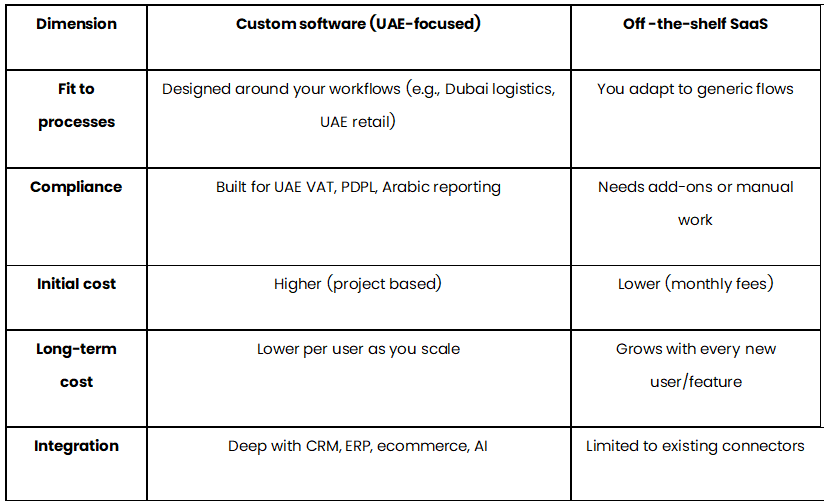
Custom pays off where processes are complex, regulated, or strategically unique; off -the - shelf fits short-term experiments and simple operations.
How to Decide in a UAE Context
Ask these questions before investing:
- · Is your process genuinely differentiating (e.g., proprietary logistics, fintech workflows)?
- · Do you operate in regulated sectors (finance, healthcare, government suppliers) in the UAE?
- · Do you plan GCC or global expansion that will increase data volumes and integrations?
If the answer is “yes” to two or more, a custom software partner in Dubai/UAE is usually safer long term.
Implementation Roadmap with a UAE Partner
- · Discovery and requirements: Map existing tools, pain points, and regulatory requirements (2–4 weeks).
- · Architecture and MVP: Design modular architecture that can grow from UAE to global use; build a minimum set of core features first.
- · Integrations: Connect to ERP, CRM, ecommerce platforms, and payment gateways used in the UAE market.
- · Iteration: Add AI analytics, automation, and advanced reporting once adoption is stable.