
24 Mar 2026
Healthcare Custom Software Development UAE: Patient Portals, EMR and Compliance

Ananth
CPO
Mar 24, 2026· 4 min read
Why Healthcare in UAE Needs Custom Software
Healthcare providers in the UAE and wider GCC operate in a distinct environment: international patient flows, mixed public–private funding, and strict oversight from regulators and insurance networks. Generic tools built for other regions often fall short once you need Arabic language support, GCC‑specific payer logic, or integration with local labs and regulators.
Regulatory demands across UAE and GCC
- Providers must comply with local health authorities and data‑protection expectations, while often also aligning with international standards for quality and accreditation.
- Clinical systems need clear audit trails, role‑based access control, and secure data storage, especially when EMR/EHR data is shared across facilities or borders in the GCC.
Multilingual patient base and medical staff
- UAE and GCC hospitals typically serve Arabic and English speakers plus large South Asian and other expatriate communities.
- Custom healthcare software UAE can support Arabic/English interfaces, right‑to‑left layouts, and culturally appropriate communication templates out of the box, which generic products rarely handle well.
Complex insurance and payer integrations
- Clinics and hospitals depend on fast, accurate processing with numerous insurance companies and TPAs across UAE and the Gulf.
- Custom medical software development UAE makes it possible to embed local payer rules, e‑claim formats, pre‑authorisation workflows, and eligibility checks directly into the clinical and billing systems, reducing rejections and delays.
Because of these factors, GCC providers increasingly search for targeted solutions using high‑intent queries like healthcare software development UAE, “hospital software development GCC”, and custom healthcare software UAE, instead of trying to bend foreign systems to fit local realities.
Key Healthcare Software Components
A modern, GCC‑ready healthcare platform usually combines several core modules into a single, integrated ecosystem rather than forcing staff to jump between disconnected apps.
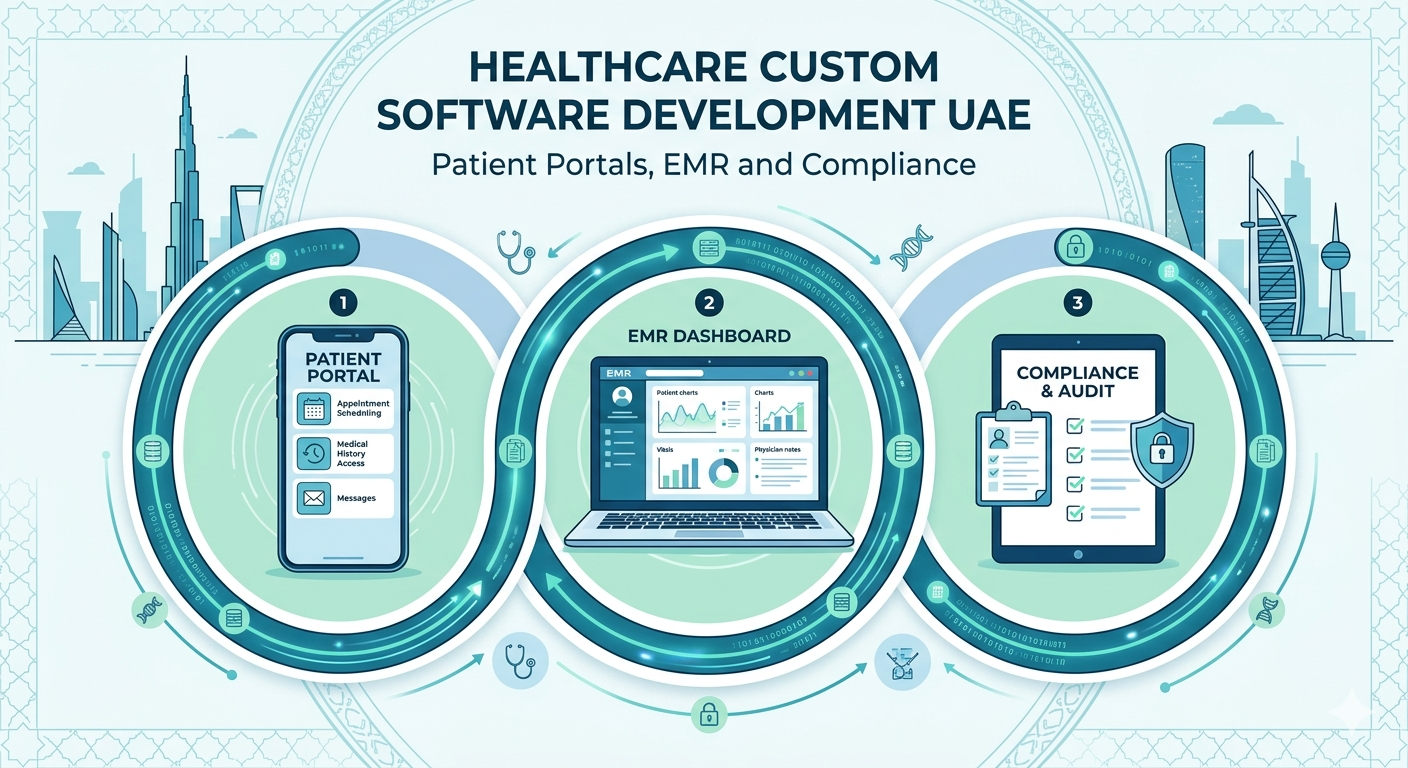
EMR/EHR (Electronic Medical Records)
- Central repository of patient demographics, clinical notes, diagnoses, allergies, medications, lab and imaging results.
- Role‑based views for doctors, nurses, pharmacists, and admin staff so each sees what they need without over‑exposure of sensitive data.
- Support for clinical coding, order sets, care pathways, and alerts to improve safety and standardisation.
Appointment and scheduling systems
- Multi‑clinic, multi‑location scheduling with provider‑specific rules, appointment types, and telehealth slots.
- Smart allocation to reduce no‑shows and balance workloads, with automated reminders via SMS, email, or WhatsApp in Arabic and English.
Patient portals
- Secure web and mobile access where patients can view appointments, results, prescriptions, and invoices, and communicate with their care team.
- Self‑service features such as online booking, intake forms, consent forms, and payment options, built to the organisation’s branding and workflows.
Telemedicine and virtual care
- Video consultations integrated with EMR/EHR, so notes and orders are linked to the same patient record.
- Remote‑monitoring capabilities for chronic disease management, with alerts to care teams when readings cross thresholds.
Billing, insurance and revenue‑cycle management
- Tight integration between clinical workflows and billing, so charge capture is complete and accurate.
- Built‑in logic for UAE and GCC insurance rules, co‑pays, authorisations, and electronic claims, reducing denials and rework.
Working With Healthcare‑Experienced Custom Software Development Services UAE
Not every software house is equipped to handle clinical and regulatory complexity. Choosing custom software development services UAE with specific healthcare experience is critical if you want safe, compliant, and future‑proof systems.
Data security and privacy by design
- Healthcare‑experienced teams design custom healthcare software UAE around security fundamentals: encryption in transit and at rest, strong identity and access management, and segregated environments for dev/test/prod.
- They implement fine‑grained permissions, logging, and audit trails so you can demonstrate who accessed what data and when, essential for internal governance and external audits.
Integration with labs, imaging, and insurance
- Interfaces to laboratory information systems (LIS) and PACS/RIS so lab results and imaging are visible within the EMR/EHR without manual uploads.
- Real‑time or batch integrations to insurance and TPA systems for eligibility, pre‑authorisation, and claim submission, adapted to UAE and regional standards.
Proven understanding of clinical workflows
- A healthcare‑savvy medical software development UAE partner understands outpatient, inpatient, day‑surgery, emergency, and home‑care contexts.
- They can map complex workflows into usable software—reducing clicks, aligning screens to how clinicians think, and handling edge cases like transfers and multi‑consultant care.
Patient and Provider Benefits
The ultimate test of custom healthcare software UAE is whether it makes life better for both patients and providers.
For providers: less admin, fewer errors, better decisions
- Integrated EMR/EHR, scheduling, and billing reduce duplicate data entry and manual reconciliations, freeing clinicians and admin staff to focus on care instead of paperwork.
- Decision‑support features and complete patient histories reduce clinical errors and missed information, especially across multiple sites in UAE and GCC.
- Management gains real‑time dashboards on patient flows, utilisation, and financials, helping them improve capacity planning and service lines.
For patients: higher engagement and smoother journeys
- Patient portals and mobile apps put key information—appointments, results, prescriptions, invoices, into the patient’s hands in Arabic or English, improving trust and understanding.
- Online booking, telemedicine, and digital payment reduce friction and waiting times, meeting the expectations of a digital‑first population in Dubai, Abu Dhabi, and the wider Gulf.
- Better coordination between providers (via integrated systems) reduces repeated tests and confusing hand‑offs, leading to a clearer, safer care journey.
For healthcare leaders searching healthcare software development UAE, medical software development UAE, or custom healthcare software UAE, these are the outcomes that justify moving beyond generic tools and investing in tailored platforms designed specifically for the UAE and GCC healthcare landscape.